Choosing home education is a decision made with care, research, and love. Every day, homeschool parents give their time to ensure their children are learning and growing. The holidays, especially Thanksgiving, can bring that choice into the spotlight in ways that feel uncomfortable. Skeptical relatives, well-meaning questions, and the occasional pointed comment are part of the territory. Here are nine common scenarios and practical responses to help you navigate them with confidence and warmth.
Why Homeschoolers Face These Questions
Home education is still unfamiliar to many people. Most adults were educated in traditional school settings and have no frame of reference for what a thriving homeschool looks like. Their questions, even when they feel like challenges, usually come from genuine curiosity rather than hostility.
📊 What the research shows: A 2009 study published in the Journal of College Admission found that homeschooled students scored an average of 72 points higher on the SAT than their traditionally schooled peers and had higher GPAs in college. A 2010 study by Dr. Brian Ray of the National Home Education Research Institute found that homeschooled students scored 15 to 30 percentile points above public school students on standardized academic achievement tests. These outcomes hold across income levels, parental education, and teaching style. When relatives raise concerns, the data is on your side.
The Montessori philosophy offers a useful frame for these conversations. Montessori believed that education should follow the child, honor individual development, and cultivate intrinsic love of learning. These are values worth sharing calmly and confidently when questions arise.
"The child is both a hope and a promise for mankind."
-- Maria Montessori
9 Scenarios and How to Handle Them
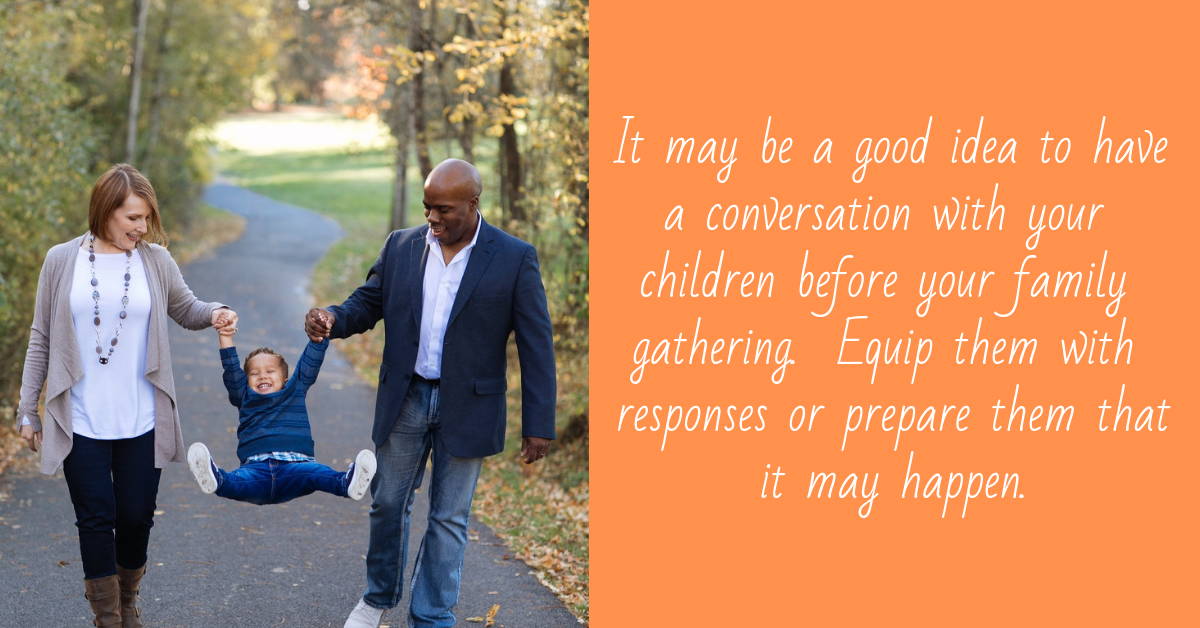
Prepare your children before the gathering. Let them know this may happen and that they are welcome to share what they know, but are never obligated to perform on demand. Depending on your child's age and comfort level, give them a few phrases to use.
Child response"I'm not sure about that one, but let me tell you about something I've been learning..." or "After we eat, I'd love to show you some of my work."
Parent response"We don't typically quiz [name] as part of our schooling, so that format is a little unfamiliar. [Name], would you like to share something you've been working on?"
Proactive approachHave your child prepare a short presentation or bring a completed project. Let relatives know ahead of time that the children would love to share what they've been learning. Grandparents especially enjoy seeing what kids have been working on.
Your children are listening to how you respond. Answer with words that build them up and reflect the joy you find in this work. This is also a chance to encourage the other parent that they could do it too, if they ever wanted to.
Quick response"I felt that way too at first. It has been a real delight."
Proactive approachShare how much you have been learning alongside your children. Most homeschool parents start without any formal teaching background, and that is completely normal and well-documented in the homeschool community.
This is a meaningful question worth answering thoughtfully. Share the joy your children find in learning. Describe specific moments when their curiosity lit up. The research here is genuinely reassuring.
Research to shareA 2006 study published in Science (Lillard and Else-Quest) found that children in Montessori environments, which share many values with home education, showed significantly higher intrinsic motivation and love of learning than peers in conventional settings.
Quick response"No. And watching them learn has been one of the best parts of this whole experience."
Proactive approachShare a specific story. Tell them about the morning your child started school on their own before you finished breakfast, or the afternoon they spent an hour on a topic just because they were curious.
This is one of the most common concerns and one of the most thoroughly addressed by research. You know your audience best, so choose your approach accordingly.
Research to shareA 2003 study by Dr. Richard Medlin found that homeschooled children score higher on measures of social maturity, leadership, and communication than their traditionally schooled peers. They also participate in a wide range of community activities, co-ops, sports, and social groups.
Quick response"That is a common concern about home education, and we are not worried about it. [Name] has a full social life."
Proactive approachShare specific details about your children's friendships, activities, co-ops, nature groups, and community involvement. Concrete examples are far more persuasive than general reassurances.
Redirect"What does socialization mean to you?" Turning the question around often opens a more genuine conversation.
Teachers who love their work sometimes feel that choosing home education implies a criticism of schools. Tread lightly and share your personal reasons with warmth. Give examples of experiences your family has been able to have that a traditional school schedule would not have allowed.
Genuine response"You know, I would be more inclined to send my children to school if more teachers were like you."
If it escalates"I think this might be a topic where we agree to disagree and enjoy our meal together."
Proactive approachIf the conversation seems to be heading that direction, redirect by asking the teacher about their classroom, their favorite subjects to teach, or what they find most rewarding about their work. People love talking about what they care about.
This one is worth preparing your children for, not just at Thanksgiving but as a general part of homeschool life. Talk with your child about stereotypes, why they form, and why they are rarely accurate. Then remind them of all the things you love about who they are.
Before the gatheringConnect with other parents ahead of time. Find out what interests the other children have and share those with your kids. Shared interests dissolve awkwardness faster than anything else.
If you overhear something unkindIntervene calmly and redirect the children toward a shared activity or conversation topic.
This is a great opportunity to share some context. Research consistently shows that homeschooled students cover academic content more efficiently than traditional school settings allow.
Research to shareStudies estimate that teachers in traditional classrooms spend 25 to 50 percent of the school day on behavior management, transitions, and administrative tasks rather than direct instruction. One-on-one or small-group learning, as in homeschooling, is dramatically more efficient. A 2009 study found homeschooled students outperformed public school peers by 15 to 30 percentile points on standardized tests.
Quick response"We are all happy with our schedule and the kids are thriving."
Homeschooling families come in every shape, size, religion, culture, and lifestyle. The stereotype is persistent but increasingly inaccurate as home education grows across all demographics.
Quick response"I have yet to meet a homeschool family who fits the traditional stereotype. We are a pretty diverse group."
Proactive approachShare how home education has grown across all family types. If some part of the stereotype does apply to your family, own it with humor. Stereotypes soften when people see the real, warm, interesting person in front of them.
This is a question every homeschool family will face eventually. The good news is that the data is strongly in your favor, and there are many well-established pathways from home education to college success.
Research to shareA 2010 study published in the Journal of College Admission found that homeschooled students had higher college GPAs and graduation rates than their traditionally schooled peers. Many colleges actively recruit homeschooled students because of their self-direction, curiosity, and strong study habits.
Pathways to shareDual enrollment at community colleges, AP coursework, early college programs, and entrepreneurial experience are all common routes homeschooled teens use to prepare for higher education.
Quick response"We are not worried about it. [Name] has excellent learning skills and a lot of options."
Redirect"I'm curious what it is about home education that makes you think it would be hard for them." Genuine curiosity often opens a better conversation than a defensive answer.
🧠 The Montessori perspective on self-directed learning: Montessori believed that children who are given freedom within a prepared environment develop the self-regulation, curiosity, and intrinsic motivation that carry them through life. Research by Angeline Lillard (University of Virginia, 2006) confirmed that Montessori-educated children showed significantly stronger executive function and academic outcomes than peers in conventional settings. These are precisely the qualities that help homeschooled students thrive in college and beyond.
The Thanksgiving table can, unfortunately, become a place of stress. Remember to keep conversations in a spirit of love. You do not have to defend yourself to anyone. The choice for home education is yours, made thoughtfully and with your child's best interests at heart. If a conversation gets heated or uncomfortable, that reminder is always enough to close it gracefully.
I hope you will not need any of this advice and that your Thanksgiving is warm, joyful, and full of good food. But I am glad to offer it just in case.
See Inside Our Montessori-Based Kits

Math Kit I
Pre-K to 3rd Grade
View Kit

Language Arts Kit A
Pre-K to 1st Grade
View Kit
🎓 Your Homeschool Coach
Montessori tips and philosophy that work, delivered straight to your inbox.
No spam, ever. Unsubscribe anytime.
Follow ShillerLearning for more Montessori-inspired homeschool tips and encouragement:
Ready to bring Montessori learning home? Explore our curriculum.
Browse ShillerLearning Curriculum →


